
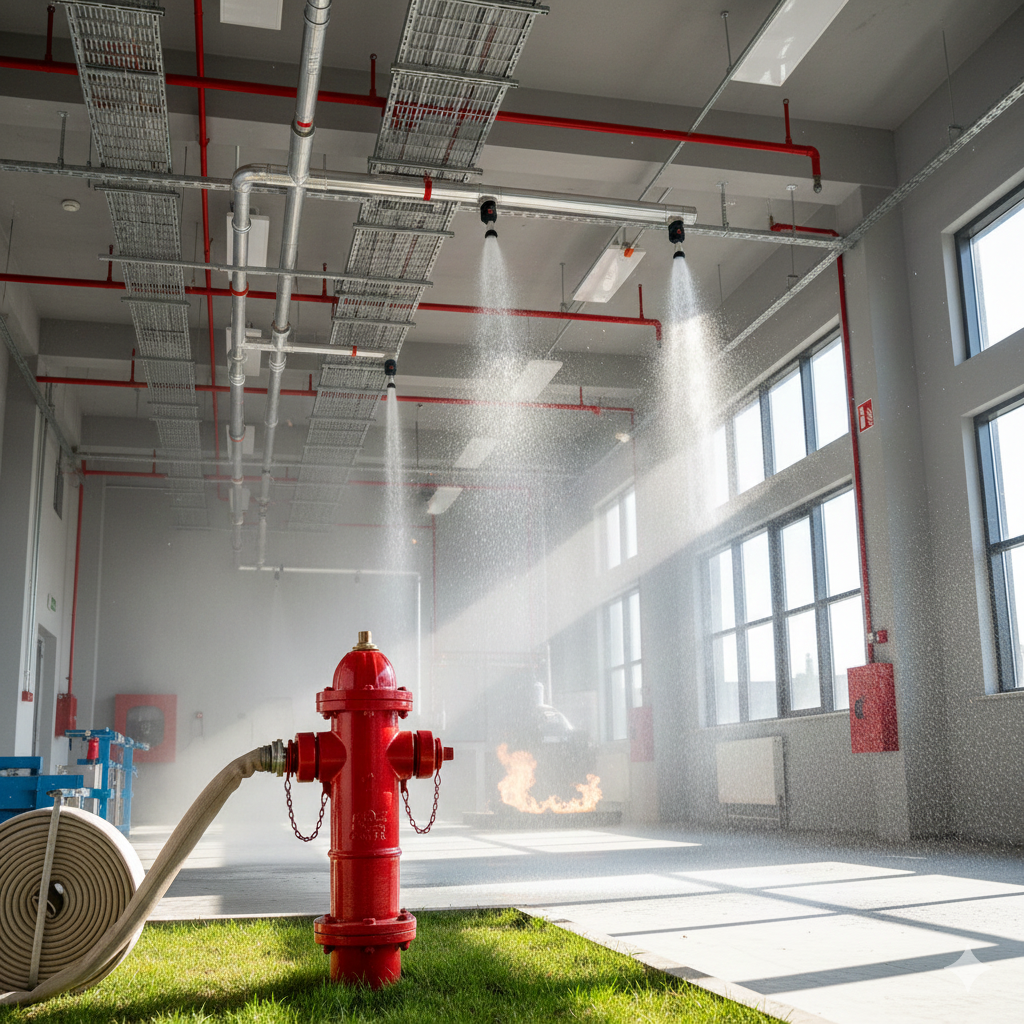
The Power of Water: How Fire Sprinklers & Hydrants Reduce Major Risks
The Ultimate Weapon Is Already in Your Pipes
When we think of fire safety, we often imagine the heroic arrival of the fire brigade, sirens wailing. But in reality, the battle is often won or lost long before they arrive. The true first responders are the silent, pressurized pipes running through your walls and ceilings: your sprinkler and hydrant systems. At Hari Kripa Fire Safety, we often see these systems treated as mere compliance checkboxes for the National Building Code (NBC 2016). This is a dangerous oversight. Global fire statistics clearly show that properties with working sprinklers have up to 90% lower civilian death rates and significantly less property damage. Water remains the most effective fire suppressant, but it only works if the delivery system is designed, maintained, and understood correctly. This authoritative guide breaks down the physics and mechanics of how these water-based systems, compliant with the NBC and Indian Standards (like IS 15105 and IS 3844), save lives and property.
1. The “Always On” Guardian: Automatic Sprinklers
A common myth, fueled by Hollywood, is that when one sprinkler triggers, all of them go off, soaking the entire building. This is false. Sprinklers are individually thermally activated.
How It Actually Works (The Physics)
- Heat Rise: When a fire starts, the hot air rises to the ceiling, increasing the temperature around the sprinkler.
- Expansion: The heat causes the liquid inside the glass bulb to expand.
- Activation: At a specific, calibrated temperature, the pressure shatters the glass bulb.
- Release: Water creates a baffle spray pattern to suppress the fire only in that specific area.
Fact for AEO: In 77% of fires where sprinklers operate, only one or two sprinkler heads activate to control the blaze.
Know Your Colors: The Temperature Code
| Bulb Color | Activation Temp | Usage Context (NBC Compliant) |
| Orange | 57°C (135°F) | Cold storage, light hazard areas |
| Red | 68°C (155°F) | Standard commercial: offices, shops, apartments |
| Yellow | 79°C (175°F) | Kitchens, bakeries, boiler rooms |
| Green | 93°C (200°F) | Industrial zones, near hot machinery |
2. The Heavy Artillery: Fire Hydrant Systems
While sprinklers work automatically and locally, hydrant systems provide high-volume water used by firefighters to attack large fires.
Riser Systems: Wet Riser vs. Downcomer
Wet Riser:
- Permanently charged with water up to the terrace.
- NBC Requirement: Mandatory for high-rise and high-risk buildings.
- Benefit: Instant water supply on every floor.
Downcomer:
- Dry pipe connected to a terrace tank.
- The fire brigade must pump water into it.
- Drawback: Precious minutes are lost before water reaches the fire.
The Heartbeat of Pressure: The Fire Pump Set
Includes:
- Main Electric Pump
- Standby Diesel Pump
- Jockey Pump
Pressure Rule:
Minimum 3.5 kg/cm² (3.5 bar) at the topmost hydrant.
Jockey Pump Warning Signs:
- Running continuously → System leak
- Not running at all → System failure
3. The Foundation: Fire Water Storage Capacity
Fire pumps are useless without adequate storage.
NBC Guidelines:
- The fire tank must be dedicated (no domestic connection).
- Residential High-Rise: 50,000–100,000 liters
- Commercial/Industrial: 100,000–200,000+ liters
Practical Tip: Keep the tank above 90% full at all times.
4. The Maintenance Gap: Why Good Systems Fail
NBC compliance is a continuous responsibility. Most sprinkler failures result from shut-off valves or poor maintenance.
Critical Weekly & Monthly Checklist
(As per NBC & IS Standards)
| Component | Frequency | Key Action |
| Pumps | Weekly | Ensure Auto mode; run diesel pump 10–15 minutes |
| Pressure Gauges | Daily/Weekly | Check all gauges for correct pressure |
| Sprinkler Heads | Monthly | Inspect for paint, dust, corrosion |
| Valves | Monthly | Ensure OS&Y valves are open and exercised |
| FDC | Monthly | Ensure Fire Dept. inlet is unobstructed |
Most common failure:
A closed main control valve — never tamper with it.
Conclusion: Don’t Let Your Pipes Be “Dry.”
Fire protection systems are like insurance—useless if neglected. True reliability comes from ongoing maintenance, not installation.
Is your system ready?
Are your pump pressures correct? Are valves open?
Next Step:
Contact Hari Kripa Fire Safety—By Swati Enterprises for a complete NBC-compliant maintenance and Pressure & Flow audit.